
By 2030, the World Economic Forum projects that AI and automation could create 170 million new jobs globally while displacing 92 million existing ones - a net gain, though one the WEF is careful to note won't be evenly distributed. It's a fitting backdrop for a conversation asking what organisations are actually doing to prepare for it.
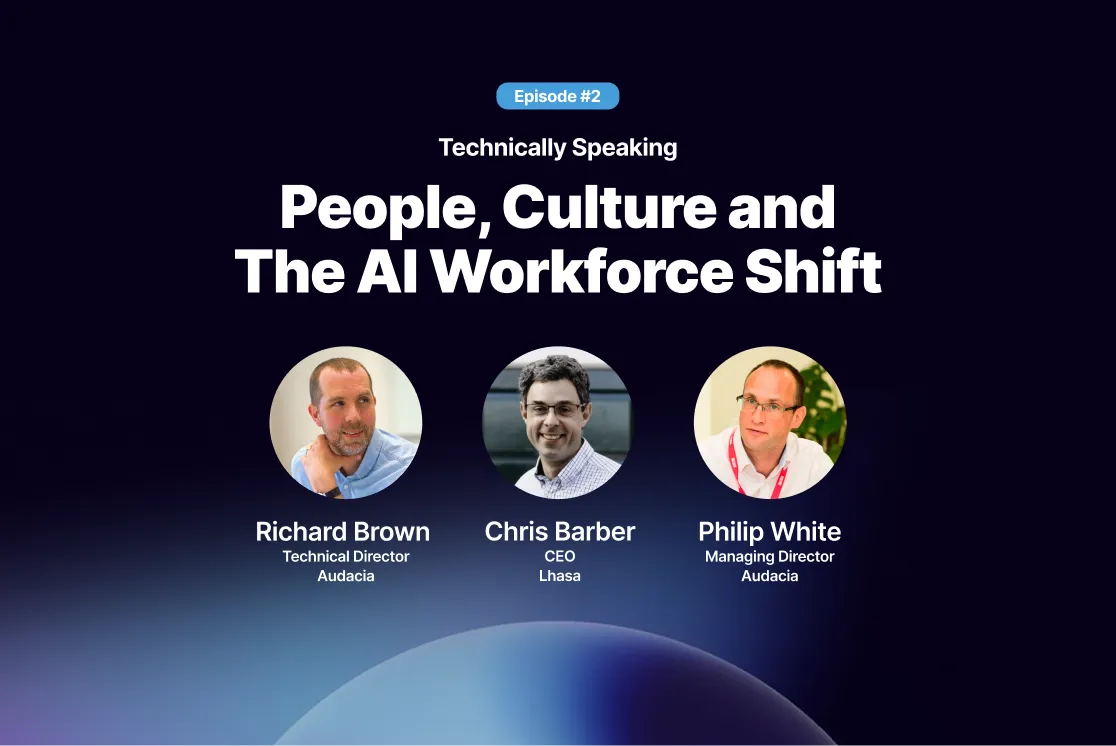
Richard Brown is joined by Chris Barber, Chief Executive of Lhasa Limited, and Philip White, Founder and Managing Director of Audacia, to talk through how AI is changing organisations and the work people do within them. Between a scientific research charity and a technology consultancy, the conversation covers how success with AI is measured, what it means for change management and hiring, and how accountability works when AI starts operating with less human oversight.
The conversation ranges across measurement, culture, accountability and the geopolitics of sovereign AI.
In this episode
- Why you need a benchmark for success to measure value from AI
- How organisations change shape as AI absorbs entry-level work
- Hiring for soft skills and culture as technical skills flatten
- Accountability and guardrails for increasingly autonomous AI
- Sovereign AI, token costs and the global inequality of access
Watch now
Listen now
Speakers
Richard Brown
Richard Brown is the Technical Director at Audacia, where he is responsible for steering the technical direction of the company and maintaining standards across development and testing.
Chris Barber
Chris Barber is Chief Executive of Lhasa Limited, where he leads teams facilitating collaborative data-sharing projects in the pharmaceutical, cosmetics and chemistry industries.
Philip White
Founder and Managing Director of Audacia, with 28 years of experience in enterprise technology delivery.
Transcript
00:00:03 Richard Brown: Welcome to Technically Speaking podcast from Audacia, where we get into the conversations happening within technology leadership. I'm Richard Brown, Technical Director at Audacia, and over the course of this series I'll be sitting down with guests that are shaping how organisations think about and apply technology. Each episode will dig into a different topic, whether that's navigating AI governance, rethinking what technology leadership looks like, or building the infrastructure and culture that makes it all possible. The conversations will be honest, substantial, and genuinely useful.
00:00:37 Richard Brown: Hello everyone. This is the second episode of our podcast. I'm joined by Chris Barber and Philip White. We're going to be talking about AI and its impacts on the workforce. It's another conversation I hope you'll find interesting. Thanks very much, both of you for being here. For anyone not already familiar with your background, could you each give us a little introduction as to who you are? Chris, start with you.
00:00:57 Chris Barber: So I'm Chris Barber. I'm the chief exec of Lhasa Limited, which is an educational charity that writes scientific software.
00:01:06 Philip White: Yeah, I'm Philip White. I'm the Managing Director of Audacia. We're a technology consultancy based in Leeds.
00:01:11 Richard Brown: OK, so AI in the workforce. I guess I'll start by asking what is the current state of AI that the two of you are seeing within organisations?
00:01:21 Chris Barber: It's really tricky because it's moving so quickly. The current state really is we're in a transition world from manual to agentic, and it's a distribution of how far we've progressed in different dimensions. It's moving really quickly.
00:01:38 Philip White: The technology has moved really quickly. The delivery has a lot of latency to it. The capability is there - I just don't think we're getting as much out of it as we could at the moment.
00:01:53 Richard Brown: And do you see, is that consistent? Do you see some real success stories, or no?
00:01:57 Philip White: I think there's definitely a massive spectrum, and I think you're going to see a bigger separation of two camps of people. There's a lot of people who are almost getting on the AI train for fear of missing out - just doing AI, jumping, grabbing hold of the nearest thing available and ticking the AI box, without necessarily getting much value out of it. And then you've got another camp of people who run good technology change programmes and use AI as a tool within it - they're definitely getting more value.
00:02:30 Richard Brown: Do you see anything, Chris, in your organisation?
00:02:34 Chris Barber: Yes, we see that same massive distribution - early adopters who are absolutely running ahead, and I guess we've now got to the tipping point where the more cautious majority are seeing the benefits of moving into it. But one of our big challenges is recognising that the entirety of how we work has to change. Improving a human-based process is always going to be limited by humans, and that's the big challenge most workforces have to go through - how do we redesign work that doesn't put humans in the loop?
00:03:09 Philip White: Yeah. This isn't a technology revolution; it's an intelligence revolution.
00:03:15 Richard Brown: So, when you say not having humans in the loop, what does that mean for the humans currently in the loop?
00:03:24 Chris Barber: If I look at where we are with some of our projects - we've got folks who are using AI to create code, they're not writing any code at all. But when it comes to testing, there's still someone manually checking in the changed code, and that's not sustainable - there's a massive backlog of code that's been written but not checked in because that manual piece is still there. That's why that rethinking is so important. We're going to have to get to the point where we don't need a human to check each task that's been done - we need different ways of measuring "good enough."
00:03:59 Richard Brown: Do you have any ideas on that, or is that just something the industry needs to get together?
00:04:05 Chris Barber: I'd love somebody to give me the answer. At the moment it feels like we need to check that the software does the right thing - does it do it consistently, robustly, reliably, securely - I think those are the important things to measure. We've got to figure out how, and it's not by looking at code coverage or checking each line of code. A lot of what we've done in the past just don't fit in that new world.
00:04:32 Richard Brown: I guess, Phil, you mentioned earlier that you see some organisations almost just ticking a box and not really getting value. How do the two of you see value from AI being measured? Is it moving faster? Is it raising a quality bar? Is it enabling things that are currently impossible to do? All of the above?
00:04:52 Philip White: I think it'll be different for different organisations, but fundamentally it's about doing things better, safer, faster. I think the big issue at the moment is clarity on what people are actually asking for - if somebody says "do AI," I hear the same thing as "we need software" - OK, but that's a huge ask. What do you actually want it for? What does good look like at the end of it? That's the big gap at the moment. It's different for everybody, but it should be clear.
00:05:23 Chris Barber: I think it's also fundamental to ask whether you actually need a piece of software to solve some of these problems at all. It may well be that we don't need bespoke software for a problem - we can do it live. With the advances in large language models, you can get answers to things you want to solve without writing a line of code or building a product.
00:05:47 Richard Brown: So almost using the LLM in real time to get answers, where before you'd have gone away and built a bespoke piece of software to do it.
00:05:55 Philip White: I know somebody using a language model as a CRM tool.
00:05:59 Richard Brown: Yeah, I wouldn't necessarily recommend that, but very good.
00:06:02 Philip White: It's hard, I started to argue against it, but I kind of said I sort of see where you're coming from.
00:06:10 Richard Brown: So do either of you have examples of where you've talked about organisations seeing real success, and Chris, you mentioned the early adopters in your organisation blazing that trail - how are those success stories being targeted? Are you picking up very targeted use cases, or is it more about experimentation and giving people room to try things?
00:06:35 Chris Barber: I think it's about solving a problem. A good example - an organisation with maybe 40-odd scientists and a similar number of software engineers - the first people to pick up software coding using AI were the scientists. Why? Because they had a problem they wanted to solve, and they thought, let's see if it works. They were the first to create a front end for a database because they wanted one and didn't have access to software resource at the time - they thought, I'll see if I can do it myself. So I think, having a well-defined problem and going for it - that's the definition of where we need to get to.
00:07:17 Richard Brown: So is it an oversimplification to say you get success where you start with a problem and you find, potentially, a solution that utilises AI, and where you're not seeing success where people start with "we need to use AI" and try to shoehorn a problem into it?
00:07:31 Chris Barber: Totally. For the last few years we've been very focused on defining outcomes and measures of success, because that's always got to be the starting point. Otherwise you say "I've got some really cool technology, what can I do with it", and OK, you'll do something cool, but will it be useful?
00:07:43 Philip White: AI is a powerful tool, but it's a tool. I think it goes back to clear objectives from the top - what does good look like, what are we trying to do before we even talk about the technology, and how much scope do I have for change here? What room do I have to play? Are we picking use cases, or is this a fundamental AI-native operating model shift? How am I allowed to approach this? And if I come back, what do I need to have done to get 10 out of 10?
00:08:22 Richard Brown: So is this about change management? Change management has been around for as long as humans have been doing organised work - is it a regular change management piece? Is there anything different here that someone who's done change management for 20 years might have to rethink?
00:08:43 Philip White: I think it's different in that you need to understand the technology. If we've now got a semi-silicon org chart floating around, how do we change the work individuals do? Oversimplifying into buckets - adoption, augmentation, automation - there's a spectrum of how AI is being adopted. Once you're into the augmentation/automation space, the set of tasks individuals do starts getting divvied out to models and agents. On the change and restructuring side, you're probably not going to see much value unless you accept that we have roles, but AI is solving tasks, and we need to work out how to move those around
00:09:33 Richard Brown: So making them more interchangeable?
00:09:36 Philip White: More interchangeable and just having that appetite for change. I think there's too much AI being implemented in little silos.
00:09:42 Chris Barber: I think there are two big changes, I think. One is that AI is progressing exponentially — it's changing really quickly so you can't just "do the change" and take it off, the way you might have done a one-off change in the past. So the thinking about change is probably the same, but the tools and approaches are entirely different. If I look back three or four years, if we wanted to change our CRM system we'd probably look at three or four options, do a deep dive into each, and spend six months agonising over which one to commit to, because it's a long-term commitment. But if you spend six months investigating, by the time you're done it'll have changed again. The speed and scope of change is so fast that you have to look at it differently - not say "is this the perfect solution" but "is this better than what I've got now, and am I locking myself into something I might need to change in the future?" So a very different way to approach a problem.
00:10:38 Richard Brown: And change when it comes to the workforce itself. How are you seeing individuals within your businesses, or businesses you work with, how are you seeing those individuals embracing or resisting change? Is there a spectrum there too?
00:10:59 Chris Barber: Definitely a spectrum. We've got the super-curious, natural tinkerers who'll try something because it's there and find a way to make it work. And there are those who are fearful of change - let's be honest, the media quite often tells you it's going to take away all the jobs and everything's going to be different, and that doesn't help either. You can't be fearful and hope it doesn't affect you - it's going to affect everything.
00:11:29 Philip White: I think there's four buckets of people: pragmatically adopting AI because it adds value; pragmatically avoiding it in spaces where you probably shouldn't use it; and then the irrational ends of the spectrum — people irrationally using it just to play with it, and people irrationally not using it because they don't understand it or are in a defensive space.
00:11:49 Richard Brown: And making a fairly decent assumption that the people resisting the change will struggle in the future. Because as you've both said, this isn't going away - you've got to get on board with it in some sense. How are you changing the hearts and minds to get those more resistant people less fearful?
00:12:19 Philip White: It's no different from a software engineer with 20-year-old ways of working - it's the same thing, just on a shorter timescale. Being a couple of years out of date is now a lot out of date.
00:12:33 Chris Barber: In the end it needs leadership though - It needs a really clear vision of where we're going, clear expectations, a path to change, and training. You have to do all of those things to give everyone the best chance of moving with the technology as it adapts.
00:12:53 Philip White: And comms around AI - where I see it get adopted well is where there's really clear communication, because if you're not communicating with people about AI, they'll just assume it's happening in the background.
00:13:02 Richard Brown: Is this around where it's acceptable to use it - best practice, essentially?
00:13:10 Philip White: I think both - the governance and usage side, who should use it, when, why and where - but the big thing is what our strategy actually is. If people are sat there wondering whether this is going to push them into the automation space and out work in a couple of years, having a clear message about where you're going and what people will be doing is really important.
00:13:40 Richard Brown: Given how fast it's moving, what could be a clear message today, by next week might be ancient history, because even the strategy might be changing. Is there a balance to strike, whereby you maybe need to be a bit slower with communication, because you don't want to tell somebody one thing one week and then a few weeks later it's changed because a more capable model has come out?
00:14:14 Philip White: I think it's about having a strategy that's broad enough and adaptable enough - it's more about the willingness to have one at all.
00:14:20 Chris Barber: I think if you wait for things to settle down, you'll never make any changes and you'll just be lost. So you have to be open and flexible, and honest that things are always changing.
00:14:32 Richard Brown: In terms of people coming into the business - have you seen changes in how hiring is happening, are you as a business looking for different skills to what you might have looked for five years ago?
00:14:50 Philip White: I don't think the skills are different, but there's more emphasis on curiosity and classic problem-solving - I think that's more important now - along with a willingness to adapt and change. The old idea of "I'd have to go and do another degree" is coming to an end.
00:15:10 Chris Barber: We used to start with hard skills - what have you programmed in, what's your scientific background, what qualifications have you got. We now start with soft skills. For us it's very much culture first —-resilience, adaptability, the flexibility to work in different environments, to try things, take risks, communicate clearly - all the things you need to work well in a team. Those skills you've always needed have suddenly become more important than ever. So we look very much at soft skills first.
00:15:39 Richard Brown: If you have somebody with all the soft skills and none of the hard skills, is that just shifting the balance, or are there some skills we genuinely don't need any more?
00:15:50 Chris Barber: I'd say if you have the ability and the aptitude to learn, you can learn the technology - but you're not going to change your natural state: your soft skills, your willingness to work in a team, your ability to react to change positively, to communicate and support others through change, and to try things. Those are innate, really, so you have to look for them carefully.
00:16:14 Philip White: Those soft communication skills - the softer side of the skill set is going to become more and more important. I think you're definitely going to see the middle get carved out, but either end of the spectrum is where people will have to straddle or pick a side. Yes, and I think on soft skills you're right - but as more automation comes through, people are going to be crying out for that human level of interaction.
00:16:39 Richard Brown: We've already seen examples where organisations put AI into customer service and six months later backtracked, because at some point people want to talk to a human being. Chris, you mentioned culture earlier and how it's becoming more important - have you seen an actual culture shift within your organisation, or is it more an emphasis on a strong existing culture?
00:17:02 Chris Barber: We've seen a shift because we've positively recruited for it - every time we've recruited, culture has been right at the front of the interview process. So yes, it does change the dynamics as a whole - it becomes a bit of a positive feedback loop.
00:17:14 Richard Brown: It becomes a bit of a positive feedback loop.
00:17:16 Chris Barber: Yeah, exactly.
00:17:20 Richard Brown: In terms of hiring - we've talked about it from the organisation's point of view - the kind of things you might look for in a prospective employee, are there things that you're seeing candidates come in and effectively demand access to these tools, or people resistant to AI thinking they're not aligned with your values?
00:17:45 Chris Barber: I guess if they're resistant, they probably wouldn't apply, because we're quite clear that AI is important. Occasionally we do get people who use AI badly and generate AI CVs full of material that's made up and fake.
00:18:03 Richard Brown: It's fairly easy to spot, surprisingly easy to spot.
00:18:08 Chris Barber: It's a bit of a trigger for me now, AI slop.
00:18:13 Philip White: In a CV come through to you? I think people coming in and speaking to you just want to know that you have a plan - everyone's coming to terms with the fact that change is coming, maybe not as fast, but probably harder than people are ready for. I think people just want to know that you have a plan - a flexible plan.
00:18:35 Richard Brown: Thinking further ahead, to the next generation - if you had somebody going to sixth form or into university, what advice would you give them to be prepared for what the next ten years may hold?
00:18:55 Chris Barber: Not locking yourself into a particular technology is going to be super important. A couple of years ago it was all about prompt engineering - and by the time universities set up degrees in it, it had already been superseded.
00:19:14 Philip White: I think you'll see some of the softer skills get more rigour in how they're taught. Business analysts, I think, are going to be one of the safest roles for a good while yet - because AI is getting better at emulating intelligence, but it can't sit in a room, watch someone say something and then say something slightly different, or pull a slight face and go, "you said that, but you pulled a face at the same time - that's not going to work, is it?" That type of skill needs to be taught.
00:19:53 Chris Barber: If you think about the old way of thinking of things - you have people doing the work, then managers, then directors - in the end we're all going to be directors. Not just managing the work AI does for us, making sure the task is done properly and the quality is correct, but directing - thinking strategically about the outcome we need and whether there's a better approach, what's the long-term future of it?
00:20:15 Philip White: But most people would agree a good manager needs experience. How do those managers get the experience if - my fear is that we're "bunny-hopping" experience. People talk about the diamond shape of an organisation that's coming, where the bottom layer shrinks - how does the middle and senior tier gain experience if they've never done the lower-level work? Or is it AI all the way up by the time we get there?
00:20:47 Chris Barber: We'll have to teach differently - and I think that's the beauty of it, AI is a fantastic teacher, so we have the tools to teach differently, we just have to accelerate. You don't need to have done arithmetic to become an accountant - in the past you used to have to do double-entry bookkeeping for years before progressing, but now you can start at a more advanced level, you don't need to start from the basics. I think the same will be true for software engineering.
00:21:21 Philip White: In that over time it's more about your ability to manage teams of people, than to manage checking lines of code.
00:21:31 Richard Brown: That's interesting. I guess we're in that middle phase at the moment. Speaking specifically about software, to verify the correctness of some AI-generated code you actually need to understand what it's done. You need to be relatively experienced to understand what good looks like, what scalability looks like, what security looks like. Are you saying it'll get to a point where code becomes like machine code or assembly — too low-level a detail for you to need to understand it?
00:22:02 Chris Barber: Yeah. I don't see why it shouldn't become a black box. If we're very clear about the inputs and outputs, and can measure the quality and correctness of those outputs, that should be enough.
00:22:12 Philip White: Yeah but it's interesting. There's a lot of structure and determinism in how we talk to computers at the moment - are we ever going to solve that? What counts as clear input? Is it natural language -subjective text? Where does that acceptable gap come from - or does the AI just emulate a business analyst, saying "you said this, but I need a bit more clarity"?
00:22:39 Chris Barber: I think that's one of the areas growing quickly now - the recognition that context is so important. It's a logical follow-on from "you don't need to write a good prompt" - if you give enough information to provide the context, the prompt can be deduced from it. Defining, explaining, capturing and making the context, of the problem, of the information you're manipulating, that becomes valuable.
00:23:07 Richard Brown: I guess context can be messy. Context can sometimes be, like Phil alluded to, the slight face that somebody pulled in a meeting. How do you get that real nuance into a language model?
00:23:23 Philip White: There's probably going to be an image classification tool for that eventually.
00:23:28 Richard Brown: Chris, you talked earlier about the move from individual contributors, to managers, to directors, and ultimately everyone ending up as a director - what does that - in terms of actually how the workforce will be directly affected do you see lots of smaller companies? How will people ultimately do work?
00:23:51 Chris Barber: Really difficult questions. We'll be able to get more done with the same number of people, that's for sure, and that probably changes the nature of what gets delivered. At the moment it's all about large, standardised software that everybody uses the same way, to do the same thing, and has to be trained on how to use that interface to do it. You could get to the point where it's bespoke - a can create a piece of software that uniquely solves one person's problem the way they want it solved - so instead of one product you end up with a thousand, each slightly different, customised and tuned to that individual person.
00:24:30 Richard Brown: That's a really interesting point — the number of organisations that shoehorn their processes to fit how, Dynamics or SAP say things work, and the amount of money spent on big SAP implementations to force that fit.
00:24:50 Philip White: Lots of tailor-made software. But going back to your point, the bigger problem is that yes, people will be able to do more, but if every organisation has the capability to do more, will we see a sufficient increase in demand to match the supply? Historically we've always absorbed increases in efficiency — the industrial revolution, computers, the internet - but my concern is that this could be bigger than all of those combined. If that's the case, will we have enough? We're going to have an abundance of electricity - are we going to have an abundance of intelligence?
00:25:42 Chris Barber: And then you've got to ask: is there a finite number of problems we want to solve with that intelligence? If the answer is no, then we can just solve more problems.
00:25:53 Philip White: So do you not think there'll be an impact on the workforce, though? I don't know - what do we say, ten years from now?
00:26:02 Chris Barber: I don't know.
00:26:04 Philip White: The Tony Blair Institute talks about a "lifespan fund", like a pension for people impacted by AI. I remember talking about universal basic income five to ten years ago and it seemed hilarious; now I think, actually, maybe this makes sense.
00:26:23 Chris Barber: The World Economic Forum recently published, and they talked about AI taking jobs away, but also said that roughly twice as many jobs are being created. So currently the trajectory is more jobs created than lost through AI - AI as a catalyst for the expansion of work.
00:26:43 Philip White: I do worry though that we're still in the adoption phase - people adopting AI tools, not yet seeing whole functions automated.
00:26:50 Chris Barber: When we get the efficiency, that might switch.
00:26:55 Richard Brown: Do you think we're preparing for that? Do you think governments..?
00:26:58 Chris Barber: Politically, no we're not. We're not thinking about four-day weeks or early retirement.
00:27:05 Philip White: But again, a four-day week seems really strange, but five-day weeks haven't been around that long either.
00:27:13 Richard Brown: You've talked a little about the problems we could solve with AI. There are an enormous number of problems in the world that could be solved - climate change, energy availability, cancer - do you see enough investment in using AI productively to solve fundamental problems that societies face?
00:27:39 Chris Barber: There are large organisations who are investing billions in order to solve fundamental problems, so it is happening - but not at scale, it's happening in pockets. That's one of the risks we see: AI doesn't enrich everybody, it enriches a small number. That's a significant risk at the moment.
00:28:00 Philip White: This is the big thing I wanted to get a view on, not to pivot completely - the impact of sovereign AI. Everyone moved to the cloud, and now there's a lot of people going "let's come back" - actually we're worried about future token costs, worried about the fact that these are artificially - you know, they're getting more expensive but they're still - there isn't yet a real free market in tokens, they're still being subsidised. Should organisations look at this from a data security and IP protection angle? As hardware costs come down, should we be looking at running models locally?
00:28:39 Richard Brown: Yeah. Because even if a local model isn't quite as powerful as what you'd get off the shelf from Anthropic, the cost-benefit may start to weigh up where actually, rather than spend however much on OpenAI models we could spend a little bit less on hardware and get results that are more than good enough, and much more sustainable long term.
00:29:01 Philip White: We don't have an AI capability problem, we have a delivery problem. People complain they don't have access to Mythos or Fable, but they're only using what they have to make their email sound better.
00:29:16 Richard Brown: When it comes to the workforce, we're looking at this very much from an industrialised, Western-society viewpoint - access to AI across the globe is massively unequal, and living in a developing country doesn't mean you pay any less for your AI subscription. How do you see that playing out - is that just about sovereign AI, governments enabling their own people to have access to these tools?
00:29:48 Chris Barber: I think we'll see broader and broader access, because it'll become a political necessity for every country to ensure it's available. And ultimately, sharing intelligence has massive potential to be equalising.
00:30:04 Philip White: Not wanting to fall down the political rabbit hole, but it requires a lot of international cooperation - and it feels like the appetite is going the other way at the moment.
00:30:14 Chris Barber: Yes.
00:30:17 Richard Brown: Bringing it back to organisations and what you're seeing with people that you're working with - in terms of that initial communication, "this is our position on AI, this is our strategy" — is that about clear, consistent messaging, is it about talking about it a lot? Is it about having advocates or champions on the ground? How can people action this in their own organisations.
00:30:51 Philip White: To move along the AI path? I think it goes back to starting at the top and getting real clarity — that's what's often missing. That strategy doesn't need to be a 12-month, 400-page exercise - just: what's our appetite for risk, for innovation, for change, for data sovereignty? What's the plan, and how does it all come together? I think if a lot of organisations spent half a day on that...because if you ask some organisations what AI means to them, the answer is just "Copilot" or "Gemini" - and it's bigger than that. Start with a clear view of what good looks like - can you do big things through small, incremental changes? Do we have an appetite for a fundamental redesign of the operating model, or do you just want individual use cases delivering value? It's old-school, nineties agile - just deliver some value, keep going.
00:32:08 Chris Barber: Yeah. You've got to know what you want to be, what you think you're going to be like in five years. If you've got that vision, everything else falls into place more naturally, and the communication isn't a grand strategy unveiled once a year - it's the micro-conversations you have every day, which let you iterate, discover things, and change position because something you thought was impossible is now enabled. That allows you to keep adapting and modifying.
00:32:40 Richard Brown: You talked about operating models - do you think company structures are going to fundamentally shift? Is "AI-native operating model" a real thing you're seeing?
00:32:52 Philip White: Yes, I think so. You might have 100 people with 50% of their tasks AI-driven and 50% not, so you're not really seeing real change or value yet. You get freedom to do other things, but you have to actually move things around.
00:33:12 Chris Barber: When I look at our old process diagrams for how we used to deliver software, it was so human-centric - somebody did something and handed it to somebody else with a different skill set to do the next thing. Whether that's a scientist designing an algorithm handed to a software engineer to code, then to a tester - that segregation of work into chunks based on individual skill sets is what has to change, because the separation is no longer that clear-cut.
00:33:42 Philip White: At the moment, most AI is on-demand - it sits and waits until somebody asks it to do something. I think the mindset shift people need to get ready for is models doing things on someone's behalf, talking to other models -
00:34:02 Chris Barber: We're already moving from back-and-forth chat into long-term, independent, autonomous running - running for hours, solving problems, not just answering a chat one line at a time.
00:34:17 Richard Brown: Where does accountability lie in that world? That's a very tricky one.
00:34:21 Chris Barber: That's a very tricky one.
00:34:22 Philip White: Yeah, I mean is it - who could it be? You've got everything right back to the model designer, whoever provided the training data, whoever did the training.
00:34:36 Chris Barber: I think it's going to fall quite heavily with the testing - that, to me, when it "leaves the factory," if you like.
00:34:42 Philip White: There's a lot of people trying to make sure the AI will be perfect. I think it's more important to have a perfect framework around an uncertain AI.
00:34:55 Richard Brown: Software isn't perfect either - AI isn't going to make -
00:34:58 Philip White: Traditional software's more consistent.
00:35:05 Richard Brown: On the lack of determinism - we've talked about the move from machine code, to assembly, to high-level languages, which is deterministic throughout - is the lack of determinism here something that makes this fundamentally different?
00:35:26 Philip White: I think it's a big shift, but something we'll get used to. Look at the responsibility developers used to have for managing memory 20 or 30 years ago - the fact that garbage collection just handles it now terrifies some people. I think it'll be that type of shift - you ask it to do a thing, it does it, and you have no idea what's actually running underneath. But it'll be a mindset shift.
00:35:52 Richard Brown: Is it just a mindset shift? Do we need more reliability in the models, or is that already there, and it's more about having the right guardrails?
00:35:58 Philip White: I think it'll be more about providing the guardrail and the validation. I think it's going to be less being very clear about how prescriptive this needs to be, and more here's what I need you to abide by and validate against, and if you can meet that, fine.
00:36:20 Richard Brown: Phil, you say you can sometimes sit in a boardroom and ask people what they think of when they think "AI," and it's "Copilot" or "ChatGPT" or whatever - is that something you've been thinking about, in terms of where you see success stories and where you see mistakes? Are the same mistakes often repeated, and the same success stories usually down to the same factors?
00:36:47 Philip White: Yes. I think the big issue at the moment is that uncertainty about what AI is and what it can do leads people to get hold of a product and take a technology-first approach. That's the biggest issue we don't see that anywhere else. To paraphrase: "I want you to go out and do software" - "OK, I'll buy Dynamics" - "What are you trying to solve?" - "I don't know, but it's a piece of software and it works, everyone else is using it" - and then you make up a problem that fits it.
00:37:24 Richard Brown: Is it the old "nobody ever got fired for choosing IBM" thing - Copilot's got the Microsoft badge, Gemini's got the Google badge, and that feels like the safe choice?
00:37:36 Philip White: Yes, and it's just a safe way to move the needle, because I think some people look at an AI strategy and fundamentally think "we don't know" - there's too much of AI falling into product and technology, and not enough asking what AI is actually good at, where it's genuinely powerful - the more abstract verbs of what we're trying to do: automate, predict, identify. That part gets skipped past quite often.
00:38:07 Chris Barber: I think we're always going to suffer from AI being a bit jagged at the edges - amazing at some things, and then other bits you wonder how can you be so stupid? The skill isn't just choosing the right tool, it's knowing how to use it - and that's probably where ownership and accountability become really important. It's not "I've done this task with this tool," it's "I've achieved this outcome, and here's the quality, here's the value."
00:38:32 Philip White: Yes - validated AI sitting alongside a human, augmented, human in the loop - still a long way to go in that space.
00:38:42 Richard Brown: Chris, you were talking earlier about being really clear, as early as possible, about the success factors and outcomes you want, and never losing sight of that.
00:38:52 Chris Barber: Yes, I think we've got to do more to work out how to measure success. There are some difficult metrics we've got to understand and learn to use.
00:39:00 Philip White: This is a massive issue for a lot of organisations - you don't want a template that just says "improvement in X as a result of AI" without knowing what X actually is at the moment. That's a big challenge - how do we validate that we're getting a return on AI investment when we have no real benchmark to measure against?
00:39:20 Richard Brown: I'm gonna ask you a very difficult question. I'm asking you to predict the future in some way. We've acknowledged this is moving incredibly fast, and if I'd asked you a couple of years ago where we'd be today, not sure you would have have guessed where we actually are. But what do you see happening over the next one to five years, in terms of AI adoption within organisations and its impact on the workforce?
00:39:49 Chris Barber: If you look back over the last couple of years and try to project forward - the early large language models weren't very good at anything, and fine-tuning was the answer, more data and more tuning to make the model better. We've now gone past the value of fine-tuning - reasoning and inference have become more important. As those things get better, we're seeing large language models handle more and more complex things well, so we may find that a lot of things get solved just with the fundamental model itself. If you look at some of the publications from Anthropic, every other week they publish about a skill that they've released that impacts massively entire sectors of software delivery - accounting, legal, or chemistry recently - so they're building capabilities that span all disciplines.
00:41:00 Philip White: Yes. It's the generic, multimodal nature of the technology. It's not that you've defined one machine learning algorithm that's good at predicting one thing, or one image classifier - these are very broad tools, which is why I think the impact is going to hit hard. In terms of where we'll be in the next few years, I think in the short term it's feeling the pain - we've seen big impact on the way code is generated, or engineering projects are being run with AI just over the last six to twelve months. But how is that being achieved? It's being achieved through context and understanding. What does that cost - tokens. The running cost of AI is going through the roof, and I worry this is funded - what's the real token cost going to be five years from now? That's a big unknown. If I knew the answer to that, it'd be easier to predict how many big "vibe-coding" GDPR data issues we'll see in the next 12 to 24 months, because I think that will put the brakes on in different areas. I think it's a bit like electricity - we've had our Franklin moment of discovering the technology, our Faraday moment of working out how to get something really useful out of it, but we're not quite at the Edison, distribution space yet. So I don't think it'll be radical in the next 12 to 24 months. But if you're going five to ten years out, once we've solved for intelligence in software, there's a second wave around hardware - robotics, humanoids - coming down the tracks. That's the next ten to twenty years, and I think that will be pretty radical.
00:43:00 Richard Brown: So at the moment if I had a kid leaving school, I'd probably tell them to get into a trade - be a joiner, be a plumber. Do you think robotics will advance a lot in 20 years? I need a shower fitted - I'll have an army of robots for that too.
00:43:17 Chris Barber: Yeah, quite likely.
00:43:19 Richard Brown: What will we do?
00:43:22 Philip White: Spending our UBI dollars.
00:43:28 Richard Brown: Very briefly, to jump back to politics - we've talked about people like Anthropic, a lot of advancement in models in the US recently, temporary export restrictions on models, and the Chinese seem to be taking a very different approach with a lot more open-weight models coming out of China. Where do you think that goes? Is that the start of "sovereign models," where actually Anthropic and OpenAI become the US sovereign models and access to them becomes much more restricted?
00:44:06 Philip White: It's becoming like a nuclear non-proliferation treaty style setup.
00:44:16 Chris Barber: Yeah. You can see it if you compare America and China - entirely different philosophies. America's going down the capitalist route of consolidating within a small number of very wealthy model owners. And China's saying they want to make intelligence freely available, because we think the greater value comes from spawning tens of thousands of companies building something new with it - so they're distributing it.
00:44:48 Philip White: Do you think that strategy is a domestic distribution for the goodwill of Chinese companies, or a mechanism for disrupting and undervaluing Western super-power AI companies?
00:45:00 Chris Barber: Both, I think.
00:45:04 Philip White: Yeah, we've seen it with DeepSeek. It was a pretty well-timed launch of DeepSeek wasn't it?
00:45:10 Richard Brown: Perfectly timed. I suspect the Chinese are seeing what the Americans are doing and thinking this plays right into what they want - it gives them more opportunity to disrupt, because more companies will look at open-weight models and adopting those over -
00:45:30 Philip White: Because there's a lot of talk about regulating AI - how do you regulate sovereign models? Sat on a piece of tin in someone's cupboard.
00:45:39 Chris Barber: It's impossible, isn't it.
00:45:40 Richard Brown: Well, people were never really able to regulate the internet either — the web.
00:45:46 Philip White: The internet, is more a communication platform than an intelligence. Yeah — I think the internet is like the roads, and AI is the car.
00:45:59 Richard Brown: The car. OK, that's a good analogy.
00:46:00 Philip White: To extrapolate that, I think we've got a lot of people staring at engines going why isn't this working - in reality, if an agent is the engine, the agent and the tooling around it is the car, and the way we connect it all together is the global infrastructure. I feel like we've should have a lot of people standing in car parks looking at engines, wondering why they're not going anywhere.
00:46:21 Richard Brown: So just to kind of wrap things up - for any leaders within a technology organisation listening, what are some actionable takeaways they can use to take meaningful action in their own organisation?
00:46:35 Philip White: I think it's about having a clear plan from the top - a clear strategy on a page - clear communication around that control-versus-creativity piece: how much do we want to empower people with AI to do amazing things, versus how much do we want to maintain process control and automation through AI? I think one of the biggest issues we see is proof-of-concept for the sake of proof-of-concept - proof of value is not value. Try to get things into production, out in the wild, and get feedback. Iterate.
00:47:13 Chris Barber: That's really good advice, and I'd add - be clear about the outcomes, be brave and try, be prepared to fail, iterate quickly and be agile, because you can't afford to be slow, and you can't afford to wait for perfection.
00:47:29 Richard Brown: So that's all for this episode of Technically Speaking. A big thank you to Chris and Phil for their time - such an interesting, topical conversation. As usual, if you found this interesting, please do subscribe wherever you get your podcasts, and feel free to share it with someone in your network. That's it for now - thanks for listening, and thanks again to Chris and Phil. I'll see you on the next one.