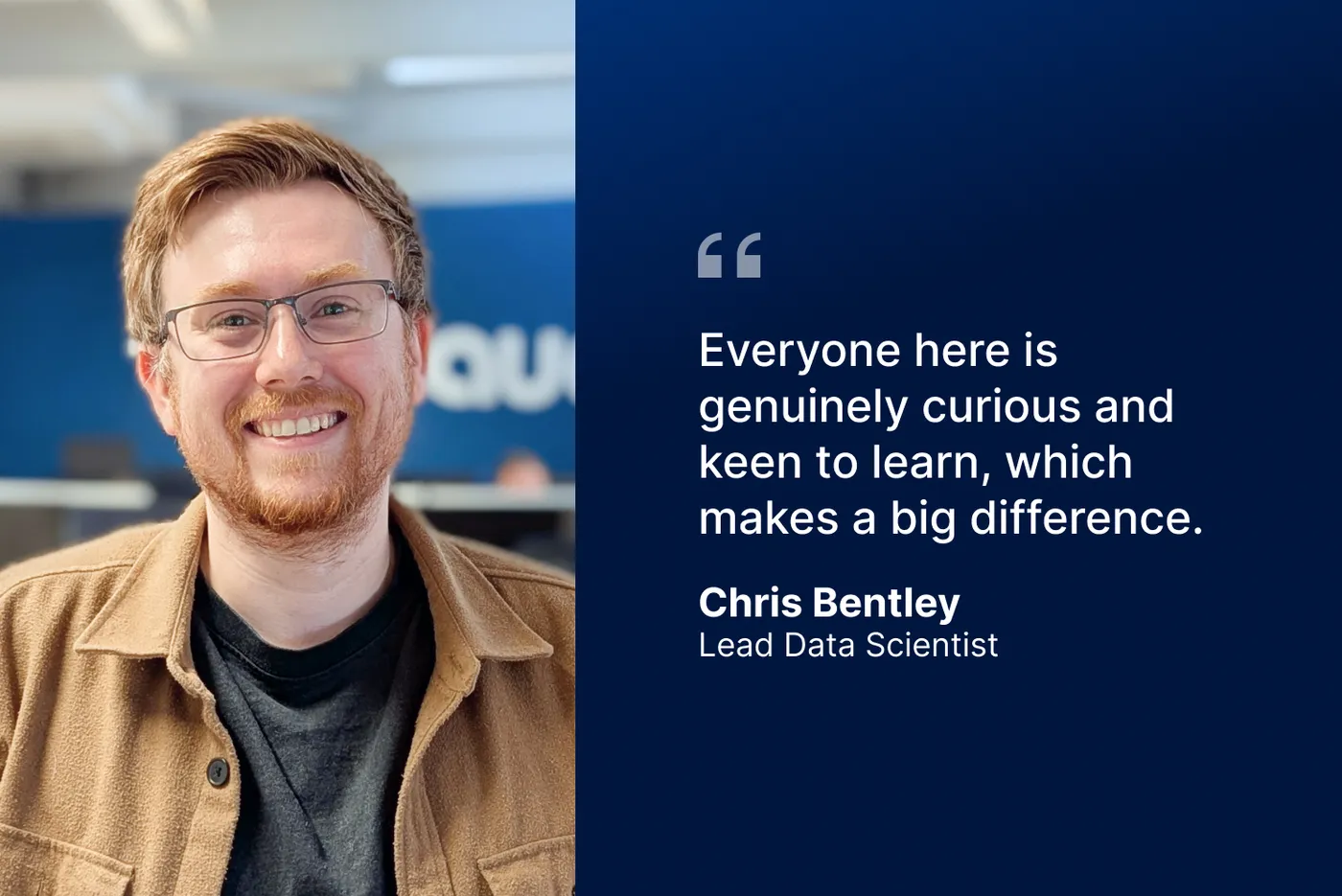
Chris Bentley is a Lead Data Scientist at Audacia. After studying astrophysics, and several years working in predictive analytics and anomaly detection for industrial clients, Chris joined Audacia two years ago, drawn by the variety and challenge of a consultancy environment. Since then, his role has grown well beyond data science alone.
What was your background before joining Audacia?
My route into data science was fairly indirect. I completed a degree in astrophysics at University of Leeds. After graduating, I knew I wanted to do more, so I went on to do a master's in astrophysics at UCL.
After UCL, I moved back up north and that's really when my data science career started properly. I worked at a remote telemetry company, where my focus was predictive analytics and anomaly detection for rail and large industrial equipment. It was interesting work, but after a while I wanted to take those skills and apply them across a wider range of industries. That's what led me to look at consultancy, and ultimately to Audacia.
What initially inspired you to pursue data science?
What I always enjoyed at university was the logical problem-solving side of things, and the computing element as well. Data science is really where those two things come together - you've got the statistics and analytical thinking on one side, and machine learning and AI on the other. As long as I was doing something that combined those aspects, I knew I'd find it rewarding.
My master's really cemented that. The focus was on what was then being called ‘big data’ in astronomy, and I was using machine learning to identify stars at very early and late stages of their life, that had effectively been hidden in the data. My thesis covered about half the sky, and the team at UCL wanted to apply it to a full sky survey afterwards, so I did a six-month paid internship with them after finishing. That was when I really started to appreciate just how powerful AI could be, and I've wanted to pursue it ever since.
What does your day-to-day look like as Lead Data Scientist?
Most of my work is grounded in the initial ideation and problem-solving stages of client projects. Clients typically come to us wanting to extract more value from the data they already have, or to improve efficiency using it, and we build a plan for how to get them there.
The process follows a fairly consistent pattern. We start with discovery - learning about the client's business and data estate - then shift into exploratory data analysis, where we look at how the available data relates to the problems they want to solve. From there, we move into feasibility work, building lightweight prototypes using either statistical machine learning or, increasingly, large language model-based approaches. The point at each stage is to be able to go back to the client and say: we've looked at this, it still looks viable, let's keep going.
The last stage I'm typically involved in is the proof of concept. That's where we know the solution is feasible and we build something tangible using the client's historic data - something they can actually get their hands on and try out. If that lands well, we'll hand it over to a delivery team to take forward.
What projects have you worked on?
The one that always sticks in my mind is the first project I worked on here. The problem was essentially one of messy data: they were processing millions of rows of transactional records, and errors kept creeping in - typos, formatting inconsistencies, the kind of thing where someone enters an O instead of a zero, or a postcode comes through wrong.
What they needed was a way to identify entries that should be considered duplicates, despite the slight differences in how they'd been recorded. I really enjoyed the pace of it, getting to work with Natural Language Processing and actually shipping something useful at the end.
More recently, I've been working with a creative agency on a project that's taken me much further into the end-to-end consulting process. It’s been rewarding learning how to get the right answers out of a client and making sure we deliver something of value to them.
How has your role evolved since joining Audacia?
Initially, the idea was that data science would be fairly separate from the wider consultancy work. However, I naturally got pulled into consultancy projects anyway. Over time, I've just become more and more involved in the full process - to the point now where I think I'm considered more a consultant than just a data scientist, though I can't quite let go of the data science aspect of it.
It's been a gradual shift, and an enjoyable one. Working closely with clients from the very start of a project, shaping how we approach a problem, and seeing it through - that's given me a much broader perspective than I'd have had if I'd stayed siloed in a purely technical role.
What technologies are central to your work, and how has that evolved?
My core stack in data science tends to be Python and Azure (when cloud service are needed), allowing me to perform things like exploratory data analysis, model building, and model deployment & observation. A lot of our work sits in that proof-of-concept or rapid experiment phase, so we use Jupyter notebooks extensively - they're essentially markdown documents with embedded Python, which lets you run small code snippets, experiment quickly and build things out iteratively before wrapping them in more formal application structures.
The biggest change I've seen since joining, though, is the boom in AI coding tools. In data science especially, the ability to use AI as a kind of sparring partner has made a real difference to how fast we can work. On a recent project, we also used AI design tooling to spin up interactive wireframes very quickly, which turned out to be far more effective than presenting a backlog of features. The client was very visual, and being able to sit in front of them and say "this is what the end product could look like" got an immediate reaction that a written specification never would have. They just said, yes, that's what we want.
The key with all of it is applying critical thinking to the outputs - these tools are powerful, but they're only as useful as the judgement you bring to them.
What opportunities have you had to develop in your role?
I've been quite lucky and have been thrown in the deep end a few times.
The time that really sticks with me is being asked to present at a vibe-coding competition - essentially a showcase of AI-assisted app development, with a room full of people who'd all written their presentations as comedy sketches. We'd built a bespoke transcription app for a hospital, and our presentation was extremely dry - "here is what we've done, here are the benefits to the client." By the time we realised the tone of the room, we had about five minutes to pivot. I managed to get a few volunteers up on stage to run through a mock doctor's appointment and demonstrate the transcription live. We got some laughs, it didn't go badly, and we even came third out of ten. But I still think about it.
Alongside moments like that, I've also been involved in the more formal side of AI development - including working on our AI governance policies, particularly looking at how we create an auditable trail of how we're using data in ways that meet ISO requirements. We've formalised our exploratory data analysis process as a standard part of discovery projects, which has been a rewarding thing to help shape.
What is the culture like at Audacia?
Everyone here is genuinely curious and keen to learn, which makes a big difference day-to-day. If you want to talk about what you're working on, people are enthusiastic and open - and if someone finds your work interesting, they'll just come and ask about it.
Data science by nature can be fairly siloed in a consultancy environment, because the work moves quickly and you're often working independently rather than in a long sprint with a wider team. But in the cases where I have worked more collaboratively, it's genuinely great - people share ideas openly and challenge each other constructively.
Audacia is a leading technology consultancy specialising in engineering, data and AI based in the UK, with headquarters in Leeds. Find out more about what it's like to work here and our current open vacancies on our careers site.