
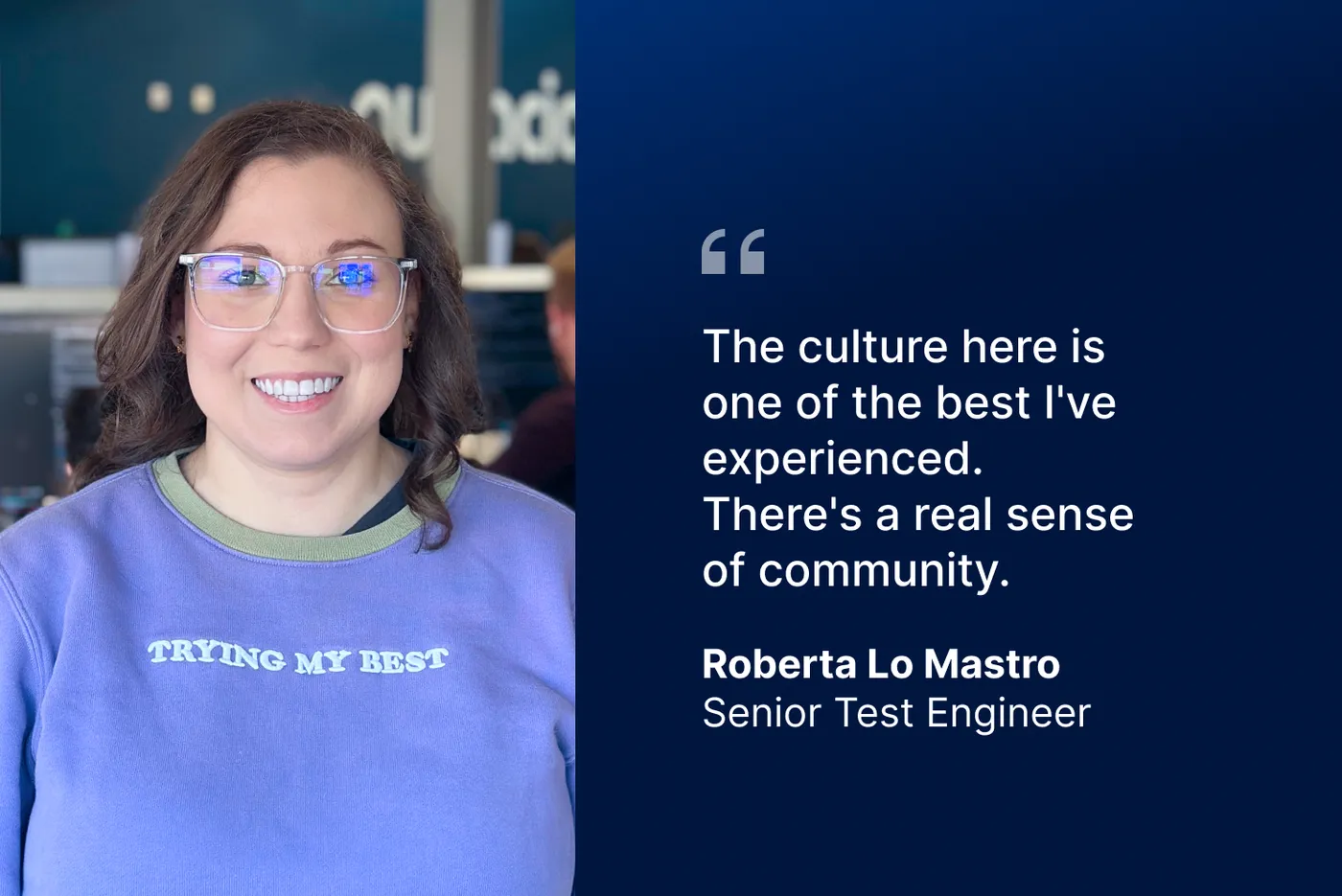
Roberta Lo Mastro is a Senior Test Engineer at Audacia. Roberta trained as a pharmacist in Italy before moving to the UK, where she found her way into technology through a graduate scheme similar to Audacia's Academy. After several years split between consultancy and in-house testing roles, she found herself drawn back to consultancy for the variety of clients and industries it offers.
What was your background before joining Audacia?
I'm not from a technical background - I studied pharmacy in Italy, then moved to the UK planning to improve my English before going back home. That didn't quite happen, and once I decided to stay, I started looking for jobs in pharmacy and in pharmaceutical and cosmetic laboratories. I realised the part of those jobs I was most drawn to was the technology and machinery involved, so I started applying for other types of roles too. I ended up finding a graduate scheme in IT that worked a bit like Audacia's Academy, with a period of foundational learning, then classroom learning, before moving onto client work. That was my first experience in IT, and it's how I found my way into technology and consultancy.
What brought you to Audacia specifically?
After a couple of years in consultancy, I moved into more permanent, in-house testing roles here in Leeds. I always found myself looking back to the consultancy world though, because as an in-house tester you have less exposure to different technologies and different types of testing. I reached a point where I wanted that excitement again: different projects, different clients, different industries. I found Audacia at the right time.
Could you give some insight into what a tester does day-to-day?
A lot of IT roles start the same way, with stand-ups and looking at the board, whether you're a project manager, developer or tester. I think what's different about testing is that you're focused on the user experience, trying to understand how someone will actually use the product - and there's a fun part in trying to break the code. That can be anything from putting bad input into a text field to see if it breaks the website, to double-clicking something that should only be clicked once. It's not necessarily a specific task on your calendar, but that curiosity is something you bring to the role every day.
What projects have you worked on, and which has been your favourite?
I've been lucky to work on a lot of short, varied projects, and I really enjoy that. I like jumping from one thing to the next. My favourite project to date involved assessing three different pieces of software and how well each integrated with a piece of specialist hardware, to help the client decide which one, if any, to partner with and offer alongside their equipment. I loved coming into the office each morning to set up the hardware, take pictures, and try to see things the way factory workers would when looking for defects on circuit boards. I learned a huge amount about hardware and it took me back to everything I’d enjoyed about my degree - it's still my favourite project so far.
Do you get to specialise in a particular area of testing, or are you more of a generalist?
From a testing perspective, the smaller the team, the more you end up doing everything - performance, security, automation, manual testing, all of it. You naturally develop the areas you enjoy most and feel strongest in, so that others can come to you with questions. Right now, my preference is for test cases and manual testing, along with test strategy and automation, which I've really enjoyed exploring. Performance testing is the next area I want to look into more. I think once you're working on a project by yourself, you end up having to do a bit of everything.
What have the teams been like across your projects?
I've worked across a really good mix of team setups. Some projects have had in-house developers with Audacia brought in purely for testing, which was interesting because not every company has the same standard of code - it makes you appreciate how technical our developers are here, and how much testing is built into the way we work. I've gone from a large project with lots of developers and testers, to being the only tester alongside in-house developers, to a small project with just two developers and me. It's a real range, but that variety is something I enjoy.
How would you describe the culture at Audacia?
I'm part of Audacia's equality, diversity and inclusion group, and I'd say the culture here is one of the best I've experienced. There's a lot of space for conversations around diversity - we've had talks on neurodivergence that I found really valuable, and a strong focus on Pride, with plenty of initiatives throughout the month. That's not something I've found everywhere, and I think it adds a lot to the culture. Beyond that, there's a real sense of community - things like bringing home baking, a craft club and a board games club. It's nice to feel part of things like that.
Would you recommend a career in testing to others?
I'd genuinely recommend testing as a career; I get to step into the shoes of people doing completely different jobs and learn specific, niche things about what their day-to-day work actually looks like. I don't think many other roles give you that.
Audacia is a leading software development company based in the UK, with headquarters in Leeds. Find out more about what it's like to work here and our current open vacancies on our careers site.